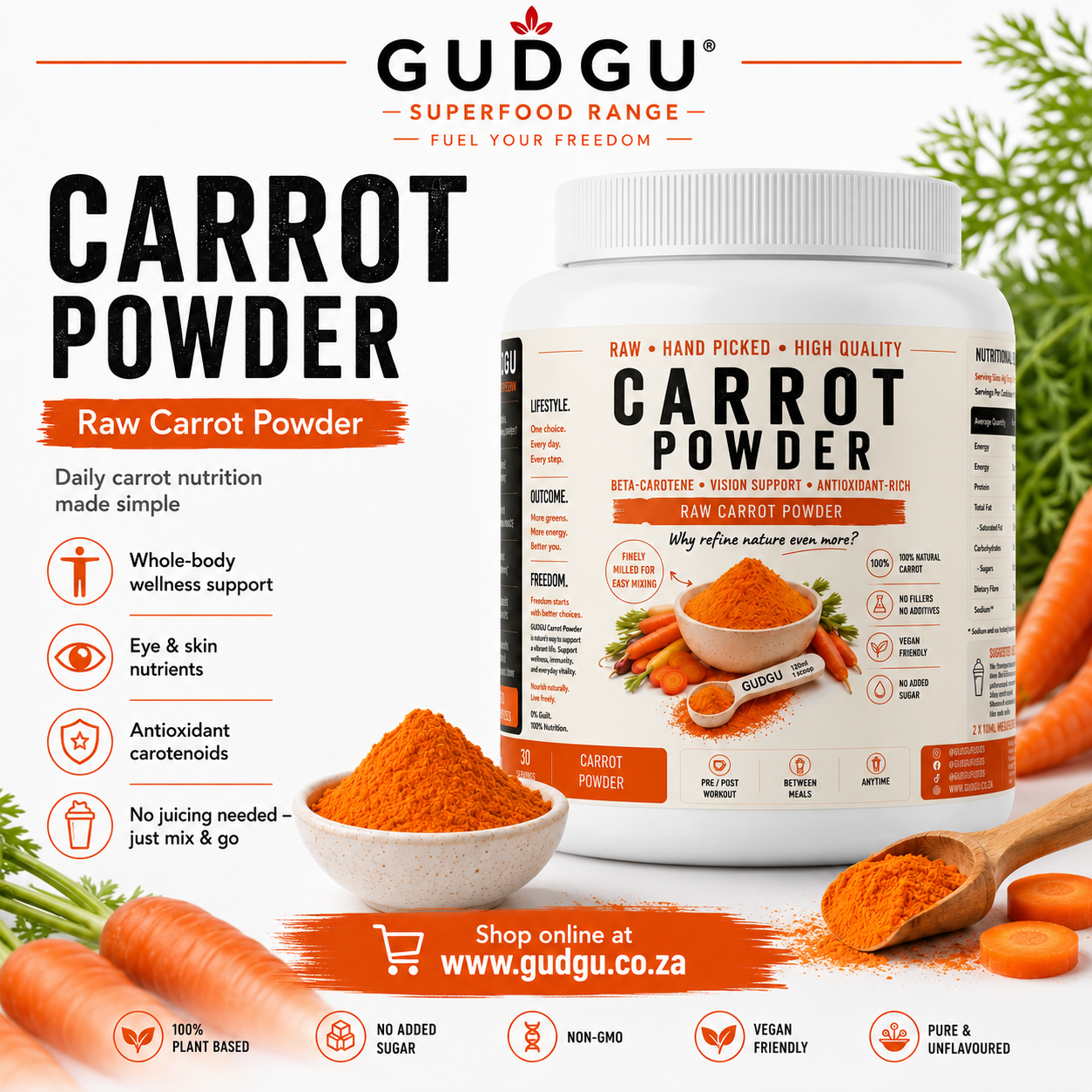

Discover GUDGU’s rare multicolour carrot powder blend – orange, purple, yellow and red carrots – plus how to use its texture and three easy recipes.
The Carrot Powder That Refused to Be Ordinary
Most carrot powders begin and end with orange carrots. Bright, finely milled, predictable.
GUDGU Carrot Powder is different.
It combines orange, purple, yellow and red carrot varieties in one dehydrated powder – each colour bringing its own natural pigments and characteristic plant compounds to the blend. It also has a noticeably rougher, more granular texture than many carrot powders.
That texture isn’t a mistake. It isn’t a silky instant-drink powder pretending to be a vegetable – it’s a substantial dehydrated carrot ingredient you can actually see and feel in the finished food.
It gives overnight oats a gentle carrot-cake texture. It gives pancakes a soft, rustic crumb. It thickens soups and sauces as it absorbs liquid. In a smoothie, it needs a proper blend rather than three hopeful stirs with a teaspoon.
GUDGU Carrot Powder looks, mixes and behaves differently – because it is different.
What Makes the GUDGU Blend Special?
The blend brings together the coloured carrot varieties GUDGU uses: orange, purple, yellow and red carrots.
We haven’t come across another commercial carrot powder that intentionally brings this combination together in one everyday product – a rare multicolour carrot blend, though we won’t claim proven worldwide exclusivity we can’t verify.
The benefit of using several carrot colours isn’t that every nutrient suddenly appears in equal quantities. It’s that the blend brings together different pigment families and plant compounds associated with each variety used.
Research on coloured carrots shows their pigment profiles differ significantly by colour and cultivar. Orange carrots tend to be rich in alpha-carotene and beta-carotene. Yellow carrots are associated with lutein. Red carrots may contain more lycopene. Purple carrots are known for anthocyanins and phenolic compounds.
The exact amounts in the finished GUDGU powder depend on the carrot varieties used, the ratio of each colour in the blend, growing conditions, harvest maturity, drying conditions, storage and the final milling process. Laboratory testing of the completed blend is needed before we can publish exact amounts of beta-carotene, lutein, lycopene, anthocyanins, vitamin A or individual minerals.
The Colour Story
Orange carrots are best known for alpha-carotene and beta-carotene. Beta-carotene is a provitamin A carotenoid – the body can convert it into vitamin A according to its needs, and vitamin A supports normal vision, immune function, reproduction, growth and the normal functioning of several organs. That doesn’t mean carrot powder gives anyone night vision – it means carrots contribute provitamin A carotenoids as part of a balanced diet.
Purple carrots contain anthocyanin pigments, though the amount varies widely between varieties. Anthocyanins belong to a group of plant compounds called polyphenols, giving many red, blue and purple plants their deep colour. Research comparing carrot varieties often finds higher phenolic content and antioxidant capacity in dark-purple or black carrots than in standard orange ones – but that laboratory antioxidant activity shouldn’t be read as a claim that the powder prevents or treats disease.
Yellow carrots are associated particularly with lutein – a carotenoid found in several yellow and green vegetables, and also present in parts of the eye. An exact eye-health claim for the GUDGU product would require laboratory confirmation of its lutein content first.
Red carrots may contain lycopene, the pigment also associated with tomatoes and watermelon. Different red carrot cultivars contain different amounts – colour alone doesn’t tell us the exact concentration in the finished powder.
Why the Texture Is Rougher
GUDGU Carrot Powder has a naturally rougher, slightly granular texture. It doesn’t disappear completely into water – it disperses through the liquid, absorbs moisture, and may gradually settle when the drink stands.
You may notice tiny particles in smoothies, juices, oats, yoghurt, soups, pancake batter and baked goods. That’s part of the product – a naturally rougher texture from our multicolour dehydrated carrot blend.
Worth knowing: roughness doesn’t automatically mean “more nutritious.” Texture and nutritional content aren’t the same thing. The nutritional variety comes from the coloured carrot blend itself; the rougher texture just describes how the powder has been milled and how it behaves in food.
How to Get the Best Texture
For smoothies: Use a blender rather than stirring by hand. Add liquid first, then fruit and other ingredients, with carrot powder added last. Blend for at least 30–45 seconds, let it stand for two minutes, then blend briefly again.
For water or juice: Use a shaker bottle. Shake thoroughly before drinking and again halfway through, as some natural settling is expected. Use cold liquid rather than stirring into a nearly full glass.
For overnight oats: The rougher texture works beautifully here – the powder absorbs moisture while the oats rest, softening into the mixture for a proper carrot-cake feel. Stir once when preparing, and again before serving.
For soup: Mix the carrot powder with a small amount of cool stock to make a smooth slurry before adding the rest of the liquid. Whisk while heating, and use a stick blender for a smoother final soup.
For pancakes and baking: Let the batter stand for five minutes before cooking – this gives the carrot particles, flax, chia and flour time to absorb moisture.
What Does a Serving Provide?
| Per 10g serving | |
|---|---|
| Energy | 36 calories |
| Protein | 0.7g |
| Total fat | 0.2g |
| Carbohydrate | 6.1g |
| Naturally occurring sugars | 3.3g |
| Dietary fibre | 1.4g |
| Sodium | 12mg |
The product contains naturally occurring carrot sugars – no added sugar doesn’t mean sugar-free.
Every batch is independently confirmed as food-grade, tested at 99.9% purity. That certificate confirms purity, not the finished blend’s vitamin, carotenoid or anthocyanin content – those figures still require separate laboratory analysis of the finished powder.
What Are the Practical Benefits?
A multicolour vegetable ingredient. The blend provides dehydrated material from several coloured carrot varieties, not just the standard orange type.
A source of dietary fibre. The panel above provides 1.4g fibre per 10g serving – a useful contribution, though the powder shouldn’t replace the fibre supplied by larger portions of vegetables, fruit, legumes, seeds and whole grains.
Naturally occurring plant pigments. The blend may provide carotenoids, anthocyanins and phenolic compounds associated with its different carrot varieties. Exact amounts require analysis of the finished product.
Convenience. No peeling, chopping, cooking or vegetable drawer involved. The container stays ready for breakfasts, soups, shakes and baking.
Colour without artificial colouring. The shade comes entirely from the carrot blend itself. Because several carrot colours are combined, the finished powder may not be the unnaturally bright orange people expect from a single-variety product – its appearance is part of its story.
Can It Replace Fresh Carrots?
No. Fresh carrots provide water, volume, crunch and the experience of eating a whole vegetable. Carrot powder is concentrated and convenient, but it should add variety to the diet, not replace every fresh vegetable.
Use both. Fresh carrots belong on plates, in lunchboxes and in salads. GUDGU Carrot Powder belongs in the recipes where fresh carrots are inconvenient, or where a dry carrot ingredient simply works better.
Does It Detox the Body?
No carrot powder performs a medical cleanse. The liver, kidneys, lungs and digestive system already handle the body’s normal waste-removal processes.
GUDGU Carrot Powder contributes plant material and fibre to a balanced diet. That’s useful, without needing to call it a detox.
Does It Boost Energy?
A 10g serving provides roughly 36 calories. It’s not a stimulant, and it doesn’t act like caffeine.
You may feel better when improving an inadequate diet generally, but the powder shouldn’t promise an immediate energy surge. Combine it with oats, fruit, yoghurt, eggs or GUDGU Whey Protein when you need a more substantial meal.
Does Carrot Powder Support Eye Health?
Carrots can supply provitamin A carotenoids, and vitamin A is required for normal vision. The exact vitamin A contribution of the GUDGU multicolour powder can’t be calculated until its carotenoid profile has been tested.
The honest version: made from a blend of coloured carrots naturally associated with a range of carotenoid pigments. We’ll hold off on a precise daily vitamin A percentage until lab results confirm it.
Three Recipes Made for the Rougher Texture
Recipe 1: GUDGU Multicolour Carrot Cake Overnight Oats
This is where the naturally rougher texture becomes an advantage. The carrot powder softens overnight, the chia thickens the milk, and the spices turn the jar into breakfast that tastes suspiciously like cake.
Prep time: 7 minutes · Chilling time: at least 4 hours · Portions: 1 large breakfast
Ingredients:
- 10g GUDGU Carrot Powder
- 40g rolled oats
- 1 scoop (25g) GUDGU Whey Protein
- 10g GUDGU Chia Seeds
- 200ml low-fat milk
- 5ml GUDGU Vanilla Concentrate
- ¼ tsp GUDGU Cinnamon Powder
- A pinch of GUDGU Ginger Powder
- A pinch of GUDGU Nutmeg
- GUDGU Erythritol or Pure Sucralose, to taste
- 1 tbsp GUDGU Pumpkin Seeds, optional
Method: Add the carrot powder, oats, whey protein, chia seeds, cinnamon, ginger and nutmeg to a jar. Stir the dry ingredients thoroughly – this distributes the rougher carrot particles evenly before the liquid goes in. Pour in the milk and vanilla concentrate, and stir until no dry pockets remain. Close the jar and refrigerate for at least four hours, preferably overnight. Stir again before eating, adding a splash of milk if it’s become too thick. Finish with pumpkin seeds for extra crunch, if you like.
Estimated nutrition per portion: Energy ~440 kcal (22% DV) · Protein ~33g (66% DV) · Carbohydrate ~54g (20% DV) · Fat ~10g (13% DV) · Fibre ~10g (36% DV) · Calcium ~340mg (26% DV) · Iron ~3.5mg (19% DV) · Magnesium ~120mg (29% DV) · Vitamin A: cannot be accurately calculated until the finished blend has been tested
Why this combination works: The carrot powder’s rougher texture hydrates and softens overnight. GUDGU Whey Protein raises the protein content. GUDGU Chia Seeds thicken the mixture and add fibre. GUDGU Cinnamon, Ginger, Nutmeg and Vanilla build the familiar carrot-cake flavour.
Storage: Keep refrigerated and eat within two days. The mixture keeps thickening – add milk before serving if needed.
Recipe 2: GUDGU Multicolour Carrot, Ginger and Turmeric Soup
This soup gives the carrot powder time to hydrate properly – starting slightly grainy, simmering into the stock, and finishing smooth after blending.
Prep time: 8 minutes · Cook time: 20 minutes · Portions: 4
Ingredients:
- 40g GUDGU Carrot Powder
- 750ml low-sodium vegetable stock
- 200ml light coconut milk
- ½ tsp GUDGU Ginger Powder
- ½ tsp GUDGU Onion Powder
- ¼ tsp GUDGU Garlic Powder
- ¼ tsp GUDGU Turmeric Powder
- ¼ tsp GUDGU Cumin Powder
- A pinch of GUDGU Black Pepper
- GUDGU Pink Salt, to taste
- 1 tbsp olive oil
- GUDGU Pumpkin or Sunflower Seeds, for serving (optional)
Method: Mix the carrot powder with 150ml of the cool vegetable stock and whisk until evenly dispersed. Leave for five minutes so the rougher particles can begin absorbing liquid. Heat the olive oil in a saucepan, add the ginger, onion powder, garlic powder, turmeric, cumin and black pepper, and stir for 30 seconds. Whisk in the hydrated carrot mixture, then gradually add the remaining stock. Simmer gently for 10 minutes, whisking occasionally. Add the coconut milk and simmer for another five minutes. Blend with a stick blender until smooth. Taste before adding pink salt, and finish with pumpkin or sunflower seeds if you like.
Estimated nutrition per portion: Energy ~130 kcal (7% DV) · Protein ~2g (4% DV) · Carbohydrate ~13g (5% DV) · Fat ~8g (10% DV) · Fibre ~3g (11% DV) · Potassium ~300mg (6% DV) · Iron ~1.5mg (8% DV) · Vitamin A and carotenoids: vary according to the final tested carrot blend
Why this combination works: Hydrating the carrot powder first prevents dry pockets. Coconut milk softens the earthy sweetness. GUDGU Ginger, Turmeric, Cumin, Onion, Garlic and Black Pepper turn the carrots into a proper savoury soup. Blending at the end smooths the naturally rougher texture, without pretending it was never there.
Storage: Refrigerate for up to three days, or freeze for up to two months. Whisk or blend briefly after reheating, as natural separation may occur.
Recipe 3: GUDGU Carrot, Granadilla and Vanilla Protein Pancakes
The carrot powder gives these pancakes a slightly rustic texture that suits the carrot-cake flavour perfectly.
Prep time: 10 minutes · Resting time: 5 minutes · Cook time: 10 minutes · Portions: 1 · Makes: ~5 small pancakes
Ingredients:
- 10g GUDGU Carrot Powder
- 1 scoop (25g) GUDGU Whey Protein
- 30g rolled oats, blended into flour
- 10g GUDGU Flax Seeds, finely ground
- 1 large egg
- ½ medium banana
- 50ml low-fat milk
- 5ml GUDGU Vanilla Concentrate
- 5ml GUDGU Granadilla Concentrate, or to taste
- ¼ tsp GUDGU Cinnamon Powder
- A pinch of GUDGU Nutmeg
- GUDGU Erythritol, to taste
- A tiny pinch of GUDGU Xanthan Gum, optional
- Cooking spray or a small amount of oil
Method: Mash the banana in a bowl. Add the egg, milk, vanilla concentrate and granadilla concentrate, and whisk until combined. Add the carrot powder, whey protein, oat flour, ground flax seeds, cinnamon, nutmeg and erythritol, plus a tiny pinch of xanthan gum if using. Mix thoroughly, then leave the batter to rest for five minutes – this matters, since the rougher carrot particles and ground flax need time to absorb moisture. Heat a non-stick pan over medium-low heat, lightly grease it, and spoon in small rounds of batter. Cook until the edges set and small bubbles appear, then turn carefully and cook the second side. Serve warm.
Estimated nutrition per portion: Energy ~450 kcal (23% DV) · Protein ~34g (68% DV) · Carbohydrate ~48g (17% DV) · Fat ~14g (18% DV) · Fibre ~9g (32% DV) · Calcium ~140mg (11% DV) · Magnesium ~100mg (24% DV) · Iron ~3mg (17% DV)
Why this combination works: GUDGU Whey Protein supplies complete protein. GUDGU Flax Seeds help bind the batter and add fibre. Banana and milk provide the moisture the rougher carrot powder needs. GUDGU Vanilla, Cinnamon and Nutmeg build the carrot-cake base. GUDGU Granadilla Concentrate adds a bright fruity edge that keeps the pancakes from tasting heavy.
Storage: Refrigerate cooked pancakes for up to two days, or freeze for up to a month with baking paper between them. Reheat gently in a pan, air fryer or microwave.
Frequently Asked Questions
Why does GUDGU Carrot Powder feel rougher than other powders? It has a more granular texture than many finely processed orange carrot powders – part of the physical character of the GUDGU multicolour dehydrated carrot blend. It’s best blended, shaken, whisked or given time to hydrate, rather than expected to dissolve like a sweetener or protein isolate.
Is the rougher texture a quality problem? No. A rougher texture isn’t automatically good or bad – it simply changes how the product should be used. It works particularly well in oats, soup, sauces, pancakes, muffins and smoothies.
Will it dissolve completely in water? No. Carrot Powder contains real vegetable particles, so it disperses rather than fully dissolves, and may settle when the drink stands. Shake again before drinking.
Does the blend contain the nutrition of every carrot colour? It brings together the characteristic pigments and plant compounds associated with the orange, purple, yellow and red carrots used – but it doesn’t guarantee equal amounts of every nutrient. The exact nutritional profile has to be measured in the finished product.
Does it contain added sugar? No. The sugar shown in the nutrition panel occurs naturally in carrots.
Can I use it in savoury food? Yes. Its rougher texture works especially well in soup, stews, sauces, dips, eggs and savoury muffins.
Can I use it for baking? Yes – let the batter rest so the powder can absorb moisture. You may need slightly more liquid than a recipe designed around a very fine powder.
Complete Shopping List
GUDGU products: Multicolour Carrot Powder · Whey Protein · Chia Seeds · Flax Seeds · Pumpkin Seeds · Sunflower Seeds · Cinnamon Powder · Ginger Powder · Nutmeg · Turmeric Powder · Cumin Powder · Onion Powder · Garlic Powder · Black Pepper · Pink Salt · Xanthan Gum (optional) · Vanilla Concentrate · Granadilla Concentrate · Erythritol or Pure Sucralose
Fresh and everyday: rolled oats · low-fat milk · light coconut milk · vegetable stock · eggs · bananas · olive oil · cooking spray · plain yoghurt (optional)
Not Just Another Orange Powder
GUDGU Carrot Powder doesn’t need to look or behave like every other powder. Its rougher texture is part of what makes it recognisable. Its multicolour carrot blend is what makes it unusual.
Orange brings its carotene story. Yellow brings lutein-associated pigments. Red brings its lycopene story. Purple brings anthocyanins and phenolic compounds.
Together, they create a rare carrot powder – more complex in colour, texture and potential plant-compound variety than a standard single-colour powder.
Blend it. Whisk it. Bake with it. Give it time to hydrate.
Shop GUDGU Multicolour Carrot Powder, GUDGU Whey Protein and the complete GUDGU Superfoods and Pantry ranges directly from the GUDGU website.
More colours. More ways to use it. One very different carrot powder.
Members: log in for your 20% off before you check out. 💛
Nutrition figures for the recipes are estimates based on standard ingredient values. The final approved GUDGU product label and laboratory analysis should always take priority.