
What is xanthan gum, how much should you use, and how does it work in sauces, smoothies and gluten-free baking? Three easy GUDGU recipes inside.
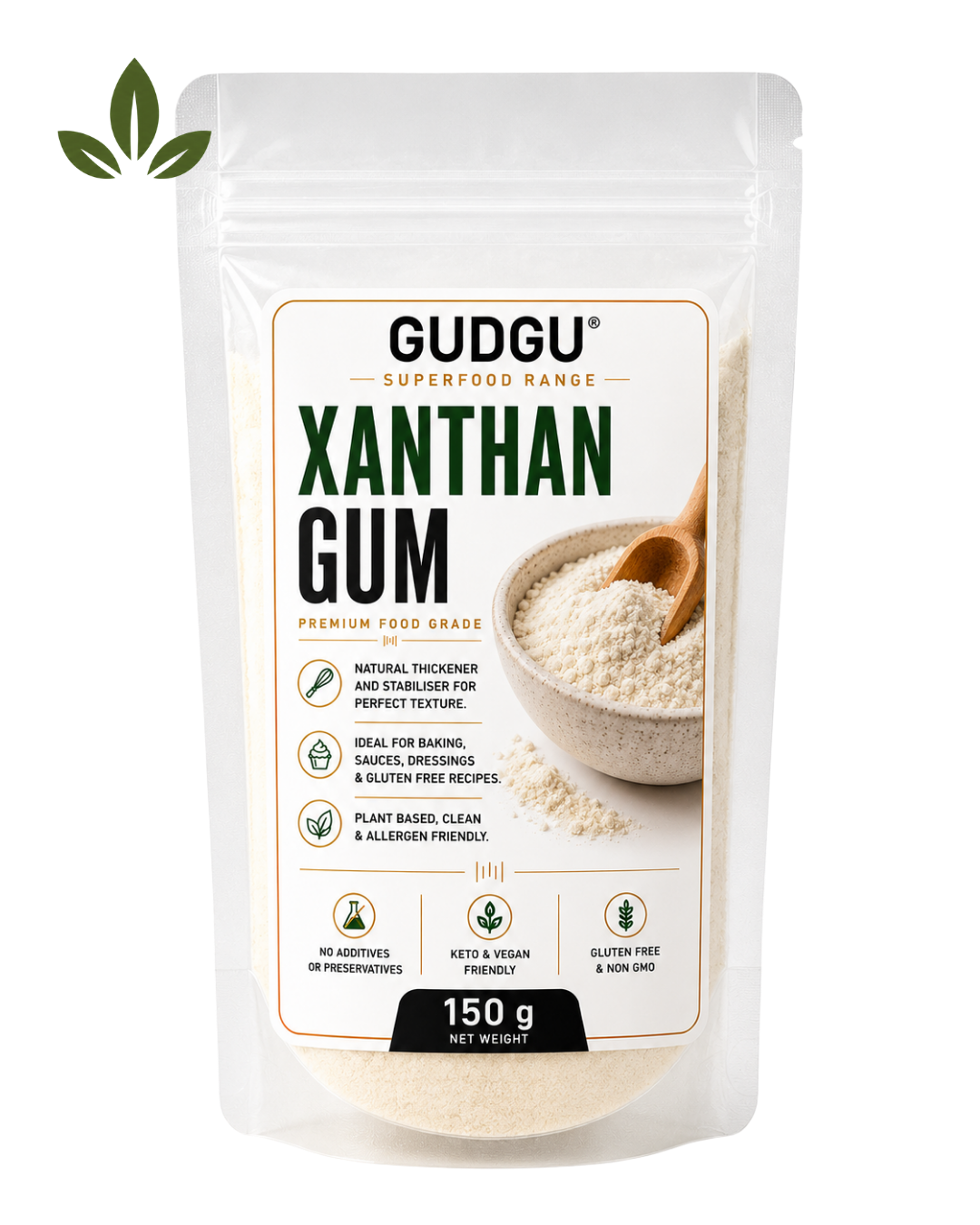
GUDGU Xanthan Gum
The tiny pantry ingredient that saves sauces, shakes and gluten-free baking.
The Little Powder With a Very Big Opinion
Some pantry ingredients wait patiently to be noticed. Xanthan gum is not one of them.
Add too little and nothing seems to happen. Add the right amount and a watery sauce suddenly turns smooth, glossy and properly behaved. Add too much, and your recipe develops the texture of expensive wallpaper paste.
That’s earned it a reputation for being mysterious. It isn’t difficult to use – it’s just powerful.
GUDGU Xanthan Gum is the tiny pantry helper that thickens sauces, stabilises salad dressings, improves frozen desserts, and gives gluten-free doughs and batters the structure they’re missing. You rarely need more than a pinch – and that pinch is the difference between a sauce that clings beautifully to your food, and one that runs across the plate looking for somewhere to hide.
What Is Xanthan Gum?
Xanthan gum is a fine powder made through fermentation. Specific bacteria ferment sugars to create a complex carbohydrate called a polysaccharide, which is then purified, dried and milled into powder. In food manufacturing, it’s also known as E415.
It’s used as a:
- Thickener
- Stabiliser
- Texture improver
- Suspending agent
- Binder in gluten-free baking
Xanthan gum is permitted for food use under prescribed manufacturing and purity standards in the US, and the European Food Safety Authority found no safety concern for the general population at typical food-additive exposure levels, concluding there was no need to set a numerical daily intake limit.
Is Xanthan Gum a Superfood?
No. That would be clever marketing and poor science.
Xanthan gum sits in the GUDGU Pantry range because it’s a functional cooking and baking ingredient – not a vitamin powder, protein supplement, or concentrated source of minerals. Its value is in what it does to food: creating texture, improving stability, and helping ingredients stay mixed. At the tiny amounts used in recipes, it contributes very few calories and little meaningful nutrition.
That doesn’t make it unimportant. Baking powder isn’t a superfood either – try making a good cake without it.
Why Is Xanthan Gum Used in Gluten-Free Baking?
Gluten does more than upset the people who can’t tolerate it. In ordinary wheat baking, it forms a stretchy network that holds dough together and traps the gas produced during baking. Take gluten out, and bread, muffins and pancakes can turn crumbly, dense or dry.
Xanthan gum helps gluten-free mixtures hold water and build more structure. Research into gluten-free bread formulations has found that hydrocolloids like xanthan gum can improve loaf volume and texture, though the ideal amount always depends on the full recipe.
It doesn’t perfectly recreate gluten. It simply helps everything else in the mix work together better.
What Does Xanthan Gum Actually Do in Food?
It thickens liquids. A tiny amount thickens gravies, sauces, soups and dessert sauces – unlike flour or cornflour, it doesn’t need a large quantity to work.
It helps prevent separation. Oil and water naturally keep to separate social circles. Xanthan gum slows that separation in salad dressings, sauces and drinks – you may still need to shake the bottle, but the mixture stays combined for longer.
It keeps particles suspended. Small pieces of herb, spice or cocoa tend to sink. Xanthan gum increases the liquid’s viscosity, helping those particles stay more evenly distributed.
It improves gluten-free texture. It binds gluten-free batters and doughs, reduces crumbling, and helps retain moisture.
It helps frozen desserts. A small amount improves the body of homemade frozen yoghurt. It won’t turn a home freezer into a professional ice-cream machine, but it can soften the hard, icy texture homemade versions often develop.
How Much Xanthan Gum Should You Use?
Very little. For most home recipes, start with ⅛ to ¼ teaspoon.
The right amount depends on your liquid volume and the result you want – a thin dressing needs less than a thick sauce, and a soft pancake batter needs less than a firm gluten-free dough.
Don’t measure xanthan gum over the bowl while telling a long story. One accidental extra shake can change the whole recipe. A digital scale that measures small amounts is useful, but ordinary measuring spoons work fine for home cooking.
A practical starting guide:
- 250ml thin drink or dressing – start with ⅛ tsp
- 250ml sauce or gravy – start with ⅛ to ¼ tsp
- Gluten-free pancakes or muffins – follow a tested recipe rather than guessing
- Gluten-free bread – use the amount specified in the recipe, since the right quantity depends on the flour, starch, eggs, psyllium and liquid involved
These are starting points, not universal rules.
How Do You Stop Xanthan Gum From Clumping?
Xanthan gum starts thickening the moment it meets liquid. Drop a full spoonful straight into water, and you’ll get small rubbery lumps that refuse to disappear.
Instead:
- Mix it into the other dry ingredients before adding liquid
- Whisk it into oil before adding water-based ingredients
- Sprinkle it slowly into a moving liquid while blending
- Combine it with GUDGU Erythritol or another dry ingredient before whisking it into a sauce
- Give the mixture a minute before adding more – xanthan gum keeps thickening after the first few seconds
The biggest mistake is deciding nothing’s happening, and adding another spoonful too soon.
What Happens When You Use Too Much?
Too much xanthan gum can leave food slimy, sticky, gummy, stringy, unpleasantly thick, or hard to pour.
It’s far easier to add another tiny pinch than to rescue a sauce that can stand upright on its own. Start small. Blend well. Wait. Then decide if the recipe needs more.
Is Xanthan Gum Safe?
Food authorities have assessed xanthan gum as safe for permitted food uses. Larger amounts may cause bloating, gas, softer stools or other digestive discomfort in some people, since it behaves as a fermentable carbohydrate – but the small amount used in an ordinary sauce or batch of pancakes is far below the quantities used in most research studies.
Anyone with a known allergy, a serious digestive condition, or a medically prescribed diet should check the product label and speak to a qualified healthcare professional where needed.
GUDGU Xanthan Gum should always be kept dry and stored away from young children. The fine powder shouldn’t be eaten by the spoonful or inhaled.
Three Small-Pinch Recipes
Recipe 1: GUDGU Chia and Flax Low-Carb Wraps
These wraps prove a tiny pantry ingredient can hold a surprisingly complicated family together.
Flax brings the nutty taste. Chia and psyllium absorb water. Egg adds protein and structure. Xanthan gum keeps the mixture flexible enough to lift from the pan without breaking into a map of small islands.
Prep: 10 min · Resting: 10 min · Cook: 10 min · Makes: 2 wraps
Ingredients:
- 20g GUDGU Flax Seeds, finely ground
- 10g GUDGU Chia Seeds, finely ground
- 10g GUDGU Psyllium Husk
- ¼ tsp GUDGU Xanthan Gum
- ¼ tsp GUDGU Pink Salt
- ¼ tsp GUDGU Garlic Powder
- ¼ tsp GUDGU Onion Powder
- 1 large egg
- 120ml warm water
- A small amount of oil or cooking spray for the pan
Method: Mix the ground flax, chia, psyllium, xanthan gum, salt, garlic and onion powder in a bowl. Whisk the egg and warm water together separately. Pour the wet mixture into the dry ingredients and stir until no dry patches remain. Leave to stand for 10 minutes so the chia, psyllium and flax can absorb the liquid. Divide into two equal portions. Place one portion between two sheets of baking paper and roll into a thin round. Remove the top sheet, then heat a lightly greased non-stick pan over medium-low heat. Turn the wrap into the pan, carefully peeling away the remaining paper. Cook 2–3 minutes, turn gently, and cook the second side. Repeat with the remaining mixture. Cool for a minute before filling.
Estimated nutrition per wrap: Energy 124 kcal (6% DV) · Protein 5.8g (12% DV) · Carbohydrate 9.6g (3% DV) · Fibre 8.4g (30% DV) · Fat 8.2g (11% DV) · Calcium 71mg (5% DV) · Iron 1.4mg (8% DV) · Magnesium 59mg (14% DV) · Potassium 136mg (3% DV) · Sodium ~330mg incl. added salt (14% DV)
Why this recipe works: GUDGU Flax Seeds give a mild nutty flavour and form the base. GUDGU Chia Seeds and Psyllium Husk absorb water and add fibre. GUDGU Xanthan Gum gives the mixture extra binding and flexibility. Garlic, onion, pink salt and black pepper can flex to suit whatever filling you’re using.
Storage: Keep cooked wraps in a sealed container in the fridge for up to three days, with baking paper between them to prevent sticking. Warm briefly in a dry pan before serving.
Recipe 2: GUDGU Silky Sugar-Free Chocolate Sauce
This sauce begins life as chocolate milk and ends up looking like it’s spent the afternoon at finishing school.
Xanthan gum thickens it without flour, cornflour, or a long boiling time. Pour it over yoghurt, pancakes, chia pudding, fruit or protein oats.
Prep: 5 min · Cook: 5 min · Makes: ~6 servings (about 40ml each)
Ingredients:
- 250ml low-fat milk
- 20g GUDGU Cocoa Powder
- 30g GUDGU Erythritol, or to taste
- 5ml GUDGU Vanilla Concentrate
- ⅛ tsp GUDGU Xanthan Gum
- A small pinch of GUDGU Pink Salt
Method: Mix the cocoa powder, erythritol, xanthan gum and pink salt in a small saucepan. Add two tablespoons of the milk and whisk to a smooth paste. Gradually whisk in the remaining milk. Place over low heat and stir gently until warm and smooth – don’t let it boil aggressively. Remove from heat and stir in the vanilla concentrate. Leave for two minutes before judging the thickness, adding a splash of milk if you want it thinner.
Estimated nutrition per serving: Energy 27 kcal (1% DV) · Protein 2.1g (4% DV) · Carbohydrate 3.9g (1% DV) · Fat 1.1g (1% DV) · Fibre 1.1g (4% DV) · Calcium 54mg (4% DV) · Iron 0.5mg (3% DV) · Magnesium 17mg (4% DV) · Potassium 113mg (2% DV) · Sodium 20mg before added salt (<1% DV)
Erythritol carbohydrates may be shown differently on product labels and may not contribute the same usable energy as ordinary sugar.
Why this recipe works: GUDGU Cocoa Powder provides the chocolate flavour. GUDGU Erythritol sweetens without ordinary sugar. GUDGU Vanilla Concentrate rounds out the cocoa. GUDGU Pink Salt deepens the chocolate. GUDGU Xanthan Gum creates the smooth, silky texture.
Storage: Keep refrigerated in a clean sealed jar for up to four days. It thickens when cold – stir in a little milk to loosen it as needed.
Recipe 3: GUDGU Strawberry Protein Frozen Yoghurt
Homemade frozen yoghurt often leaves the freezer soft and hopeful, then returns the next morning disguised as a strawberry paving brick.
Whey protein adds body and protein. Xanthan gum improves the texture. It will still freeze firmly – this is a home recipe with far less sugar than commercial ice cream – so leave it at room temperature for a few minutes before scooping.
Prep: 10 min · Freezing: 4–6 hours · Makes: 6 portions
Ingredients:
- 500g plain low-fat Greek-style yoghurt
- 150g frozen or fresh strawberries
- 100ml low-fat milk
- 1 scoop (25g) GUDGU Whey Protein
- 10ml GUDGU Strawberry Concentrate, or to taste
- 30g GUDGU Erythritol, or to taste
- ¼ tsp GUDGU Xanthan Gum
- 5ml GUDGU Vanilla Concentrate
- A tiny pinch of GUDGU Pink Salt
Method: Mix the erythritol and xanthan gum together in a small bowl. Place the yoghurt, strawberries, milk, whey protein, strawberry concentrate, vanilla concentrate and salt in a blender. Begin blending on low speed, then sprinkle in the erythritol and xanthan mixture while the blender runs. Blend until completely smooth, tasting and adjusting sweetness as needed. Pour into a shallow freezer-safe container, cover, and freeze – stirring firmly after one hour and again after two hours to break up ice crystals. Freeze until scoopable, and remove from the freezer 10-15 minutes before serving.
Estimated nutrition per portion: Energy 93 kcal (5% DV) · Protein 12g (24% DV) · Carbohydrate 6g (2% DV) · Fat 2.2g (3% DV) · Fibre 0.5g (2% DV) · Calcium ~120mg (9% DV) · Potassium ~180mg (4% DV) · Vitamin C ~15mg (17% DV) · Sodium ~65mg before added salt (3% DV)
Why this recipe works: Greek-style yoghurt brings creaminess and protein. GUDGU Whey Protein raises the protein content and adds body. GUDGU Strawberry and Vanilla Concentrates deepen the flavour. GUDGU Erythritol sweetens without ordinary sugar. GUDGU Xanthan Gum stabilises the mixture and improves the frozen texture.
Storage: Keep frozen in a sealed container for up to two weeks – it firms up the longer it’s frozen. Leave it at room temperature before scooping.
Frequently Asked Questions
Is xanthan gum the same as psyllium husk? No. Both can help bind ingredients and retain moisture, but they behave differently – psyllium absorbs a large amount of water and forms a visible gel, while xanthan gum thickens and stabilises using a much smaller quantity. Some recipes use both, because they’re doing different jobs.
Is xanthan gum keto-friendly? It’s commonly used in low-carbohydrate recipes because only a tiny amount is needed. Whether a full recipe suits a specific eating plan depends on every ingredient and the portion size – not just the xanthan gum.
Does xanthan gum contain gluten? It’s commonly used in gluten-free recipes. Customers who need strict gluten avoidance should always check the specific product label, allergen statement and manufacturing information rather than assuming every brand is certified gluten-free.
Can I use xanthan gum instead of cornflour? Sometimes, but not spoon for spoon. Cornflour usually needs heat and larger quantities; xanthan gum works at very low levels and can thicken cold liquids too. Use a recipe designed for xanthan gum rather than substituting tablespoon for tablespoon.
Can I add it to a smoothie? Yes – use only a very small pinch, blend it into the moving smoothie, and wait before adding more. Chia seeds, banana, yoghurt, frozen fruit and GUDGU Whey Protein can already thicken a smoothie plenty, so xanthan gum may not always be necessary.
Why did my sauce turn slimy? You probably used too much. Xanthan gum is powerful enough that a difference of ⅛ teaspoon can matter in a small recipe. Thin it with more liquid, or make a second batch without xanthan gum and blend the two together.
Complete Shopping List
GUDGU products: Xanthan Gum · Flax Seeds · Chia Seeds · Psyllium Husk · Cocoa Powder · Erythritol · Pink Salt · Garlic Powder · Onion Powder · Black Pepper · Whey Protein · Strawberry Concentrate · Vanilla Concentrate
Fresh and everyday: eggs · low-fat milk · plain low-fat Greek-style yoghurt · strawberries · cooking spray or oil
A Tiny Pinch. A Much Better Result.
GUDGU Xanthan Gum isn’t the loudest product in the Pantry range. It doesn’t have the colour of turmeric, the crunch of pumpkin seeds, or the drama of cocoa powder.
It works quietly behind the scenes. It holds the wrap together. It keeps the dressing mixed. It turns cocoa and milk into a silky sauce. It helps frozen yoghurt feel smoother, and gluten-free baking behave more like baking.
The secret isn’t using more. The secret is learning how little you need.
Shop GUDGU Xanthan Gum and the full GUDGU Pantry range directly from the GUDGU website.
Keep one packet in the cupboard. Use one tiny pinch. Save one more recipe.
Members: log in for your 20% off before you check out. 💛
Nutrition figures are estimates based on standard ingredient values and may vary according to the brands, exact quantities and serving sizes used. Always follow the information printed on the GUDGU product label.